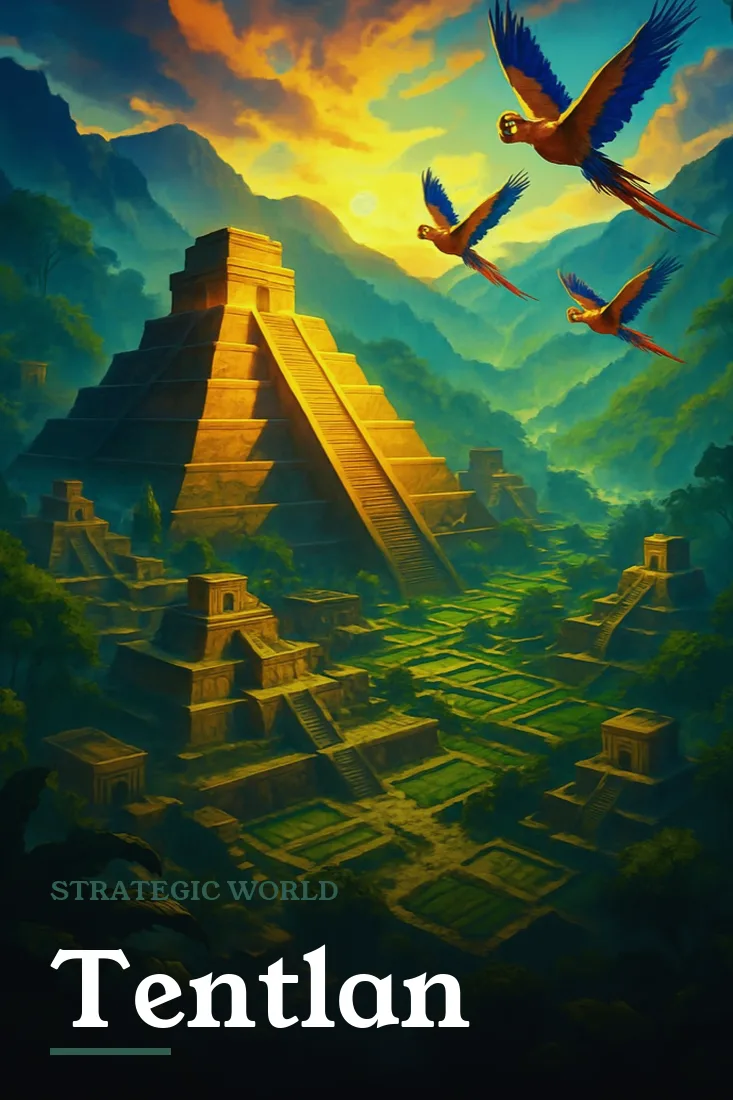
Most empire games on our list have a shared ancestry in Greek islands and medieval villages. Tentlan steps somewhere else entirely, into a world of stepped temples, maize fields, cocoa plantations and warriors dressed as jaguars and eagles. The setting alone would be refreshing, but the bigger surprise is how differently the economy behaves once you start playing.
In Tentlan, resources do not simply pile up while you are away. Production is something you order and collect, the seasons are something you can change through ritual, and the research tree responds to both. It took our editors a few days to stop playing it like Travian, and once we did, it revealed a thoughtful, distinctive game that rewards a calm, deliberate style.
Production you gather by hand
The defining choice in Tentlan is manual production. Instead of a field that ticks away untouched, your buildings produce when you give them orders, and you collect the results yourself. That sounds like extra work, and in the first hours it is, but it changes the rhythm of the game in a way we came to like: each visit becomes a small planning session rather than a glance at a number.
There is a defensive logic to it as well, since resources still waiting in a building are not sitting in your stores for raiders to carry off. Corn is the quiet essential, feeding the whole system, and a shortage slows production sharply. Learning to keep the corn flowing while setting longer orders before bed is the first real skill Tentlan teaches.
Dances, feasts and the turning of seasons
The Moon Temple is the most unusual building on our whole list. Through rituals, you can call on divine favour for your city: dances shift the season, while feasts grant temporary advantages to your forces. Seasons matter, because they change how your city performs, and some research stays locked until the season has been changed.
We found this genuinely strategic. Planning a building push for the season that suits it, or holding a feast for the day your army marches, gives Tentlan a sense of timing that most browser strategy games lack entirely. It also asks you to read the help pages carefully at first, since the effects are not always obvious from the interface alone.
Jaguars, eagles and the barbarian frontier
Military power comes from the Jaguar Temple, where you recruit your forces, including the legendary jaguar and eagle warriors. Combat is real-time on a shared world map, and you can test your army against barbarian villages before you risk it against other players. That gentle on-ramp is welcome, especially for anyone arriving from calmer builders.
Player-versus-player fighting is very much present, but the game’s own philosophy, that winners are not simply those with the most resources or units, felt accurate on our world. Clever timing of rituals and production mattered more than raw numbers. Battles here feel more like the result of preparation than of who logged in first.
Tribes and the long climb
Like its genre cousins, Tentlan lets you join a tribe and cooperate with other players, sharing information and coordinating defence. Our world’s tribes were smaller and quieter than those in Travian or Tribal Wars 2, which suited the game’s steady pace but made the political side less gripping. The market lets you trade surplus with other players when production runs lopsided.
Progress is slow in a satisfying way. Research expands your civilization’s knowledge step by step, new buildings open new options, and the city that emerges after a month feels like a project you shaped deliberately. The mobile app is useful for collecting production on the move, which suits the frequent, short visits this game prefers.
Your opening week in Tentlan
- Learn manual production first: set orders in each building, then collect them on your next visit.
- Keep corn plentiful, since a shortage slows your whole economy to a crawl.
- Build toward the Moon Temple and read what each dance and feast actually does.
- Test your first warriors against barbarian villages before you provoke other players.
- Join a tribe for advice and trade, even if you plan to play quietly.
What won us over
- A Mesoamerican setting that feels fresh beside Greek and medieval rivals.
- Manual production turns every visit into a small planning session.
- Season rituals add real timing strategy to building and research.
- Barbarian villages give new commanders a safe place to learn combat.
Where the empire creaked
- Manual collection can feel like chores before its rhythm clicks.
- Ritual effects are not always clear from the interface alone.
- Smaller tribes mean less political drama than the genre’s giants.
The commander Tentlan was made for
Tentlan suits patient planners who want something other than another Greek or medieval map. If you like systems built around timing, and enjoy checking in to set orders rather than simply glancing at numbers, it will reward you. Players craving constant war will find it slow.
Where Tentlan lands after a month
Tentlan is the most inventive economy on our list. Manual production and season rituals give it a rhythm unlike anything else here, and the Mesoamerican setting is a genuine breath of fresh air. Its systems take time to understand and its community is smaller than the genre’s veterans, but for a thoughtful player who enjoys timing, it is a quietly absorbing world.