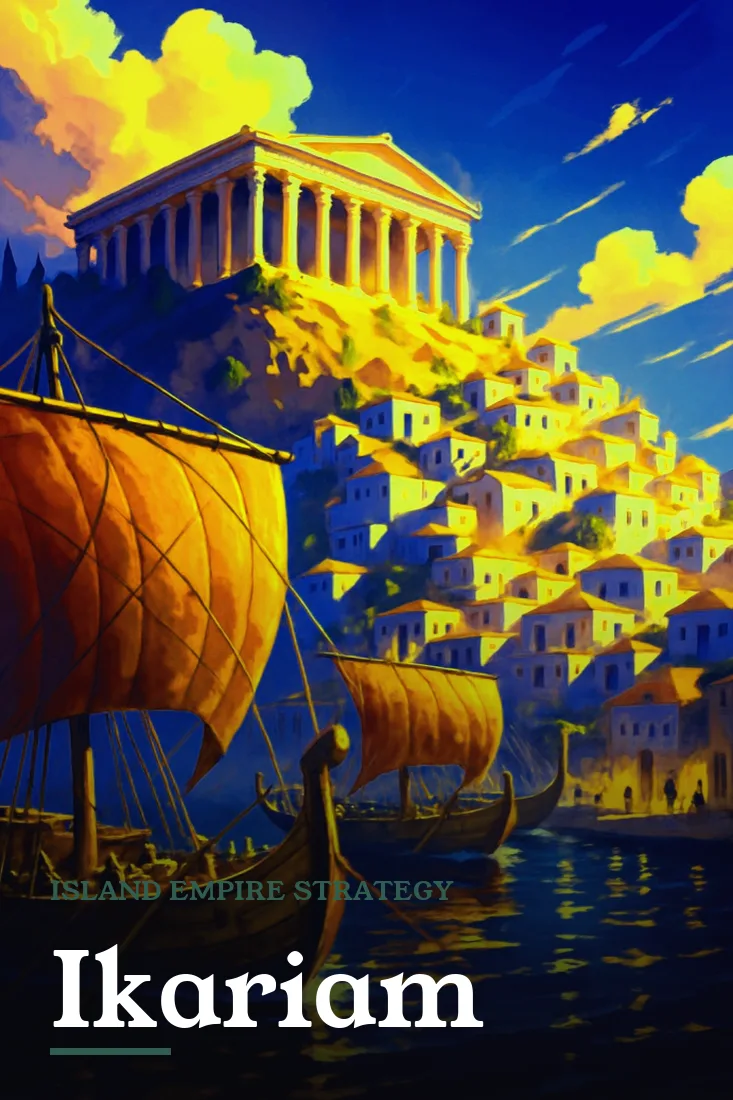
The first lesson of Ikariam arrives quietly. You look at your island and see a sawmill and one other source of wealth, perhaps a vineyard, perhaps a quarry. Everything else your town will eventually need, from the marble for grand buildings to the sulphur for an army, lies somewhere else. From that moment the game is about reaching it.
That single constraint gives Ikariam a different heartbeat from the war-first games on our list. Your early weeks are spent planning trade, choosing where to found colonies and keeping your citizens happy, and fleets exist as much to carry goods as to sink rivals. It is the game our most economically minded editor would not stop talking about, and the one that fitted most easily around a working week.
Wood everywhere, luxuries somewhere else
Ikariam runs on five resources: wood, wine, marble, crystal glass and sulphur. Every island has a sawmill for wood and exactly one of the four luxury producers, whether a vineyard, a quarry, a crystal mine or a sulphur pit. Players on the same island share these sources and can donate to upgrade them, which makes neighbours partners before they become rivals.
Your citizens are the engine. They can pay taxes in gold or be sent to work the island’s wood and luxury sites, and the balance between the two is the first real decision of each day. Keep them content, with wine flowing and taverns built, or they drift away. It is a gentle, readable economy, and getting it humming is satisfying in a way that never quite wears off.
The trading port and the art of the cargo run
Your trading port is where Ikariam’s logistics happen. Cargo ships, bought with gold, carry resources and units between islands, each holding a set load before upgrades. Sending marble from your colony to your capital, or wine to a town whose citizens are getting restless, becomes a regular little ritual, and planning those routes is half the pleasure.
Trade with other players runs through the trading post, and the most efficient players we met ran networks of agreements stretching across several islands. Colonies are the other answer to scarcity: found a second town on an island with the luxury you lack, and your empire becomes self-supplying. Choosing that island is the game’s most consequential early decision, and we argued about ours for days.
Four branches of learning in the Academy
Research in Ikariam is split across four trees: Seafaring, Economy, Science and Military. Your scholars generate research points over time, and each discovery unlocks buildings, units or efficiencies. Foreign Cultures, in the Seafaring branch, opens the embassy and with it the door to alliances, which gives the tree a natural order for a new player.
We liked how research fed back into the economy. Better ships make trade cheaper, better administration makes larger empires manageable, and military research arrives in good time for the moment your neighbours start looking hungry. The pace is steady rather than thrilling, but it gives the middle weeks a constant sense of progress that the more warlike games sometimes lack.
Fleets, sieges and island wonders
War exists, and it is not gentle when it comes. Fleets blockade ports, land armies besiege towns, and the military adviser keeps a log of combat reports for every land and naval battle you have fought. Pillaging a careless neighbour’s warehouse is a perfectly valid way to solve your sulphur problem, and many players do exactly that.
Each island also carries a wonder that its residents can raise together, granting a special effect to those who share the island. It is a lovely cooperative touch, and on our world it did more for island friendships than any diplomatic message. Alliances themselves are organized with roles such as diplomat, general and home secretary, which suits the game’s orderly, administrative tone.
Your opening week in Ikariam
- Read your island first: note which luxury resource it produces and who else lives there.
- Balance citizens between taxes and work at the sawmill, then adjust daily as the town grows.
- Build a tavern and serve wine early, since unhappy citizens leave and growth stalls with them.
- Head into the Seafaring branch of research to unlock the embassy and alliance play.
- Pick a colony island with the luxury good you lack, and save for the move.
What won us over
- One luxury per island makes trade and cooperation central rather than optional.
- Cargo runs between your own towns feel like running a real maritime economy.
- Shared island wonders turn neighbours into partners with a common project.
- Relaxed timers fit a busy working week better than most rivals.
Where the empire creaked
- The art and interface feel dated beside newer games in the genre.
- Desktop browser only; there is no official app to check towns on the go.
- Alliance life is quieter, so warlike players may find worlds sleepy.
The commander Ikariam was made for
Ikariam suits the strategist who likes economies more than battles: the player who enjoys watching a trade route fill a warehouse and planning a colony around a missing resource. It fits a busy life well, and rewards steady attention. Pure warlords will find it too gentle.
Where Ikariam lands after a month
Ikariam is the most distinctive economy on our list and the easiest to fit around a normal week. Its one-luxury-per-island rule turns trade from an optional extra into the backbone of the game, and the cargo runs, colonies and shared wonders give the whole thing a warm, cooperative feel. It looks its age and stays on the desktop, but the design underneath is still sharp.